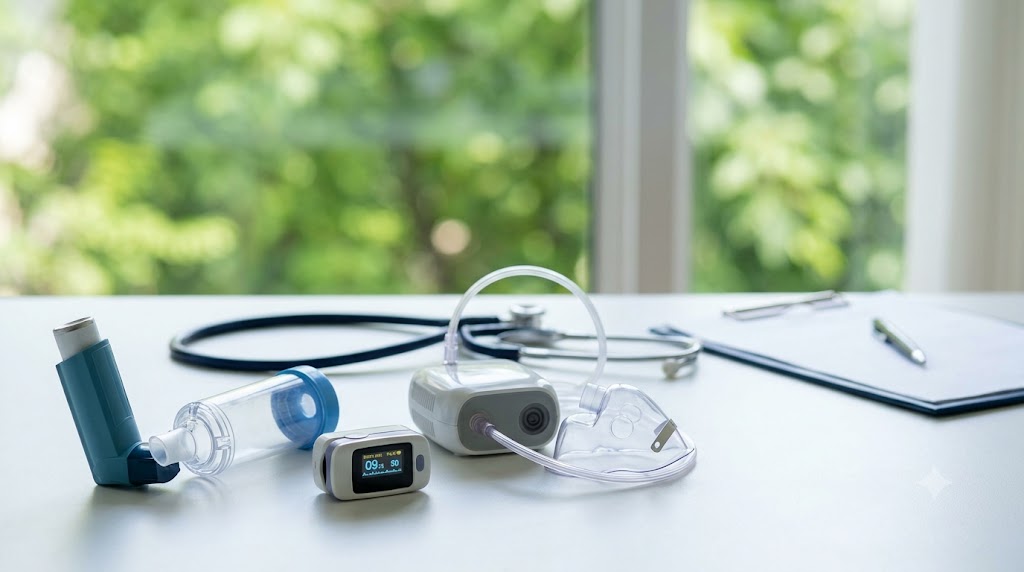
Living with asthma or COPD in Kerala means paying attention not only to your medicines but also to your surroundings. During the monsoon, dampness, mould, dust mites, respiratory infections and indoor air quality can aggravate breathing symptoms in some people. We recommend using your prescribed inhaler or nebuliser correctly, avoiding known triggers and keeping your respiratory medicines and equipment ready.
If you live in Kerala, you already know how quickly the environment can change.
One day it is humid and raining. The next day the roads are dusty. Construction work, traffic fumes, damp walls, mould, cleaning products and household dust can all become part of the air we breathe.
For someone with asthma or COPD, those environmental changes can be particularly important.
At Budget Pharmacare, we regularly meet customers looking for:
-
Asthma inhalers
-
COPD inhalers
-
Nebuliser machines
-
Nebuliser accessories
-
Bronchodilator medicines
-
Respiratory medicines
-
Affordable generic medicines
-
Inhaler refills
-
Medicines for breathing difficulty
-
Nebuliser medicines for children and adults
But we also hear an important question:
“Do I really need a nebuliser, or is my inhaler enough?”
There isn't one answer for everyone.
An inhaler and a nebuliser are different delivery methods, and the right treatment depends on the medicine prescribed, your condition, your age, your symptoms and your doctor's instructions.
So in this guide, we want to explain how we approach asthma and COPD medicine and equipment at Budget Pharmacare—especially during Kerala's humid and rainy seasons.
Why Can Kerala’s Weather Matter for People With Asthma or COPD?
Kerala's climate is not itself a diagnosis or a direct cause of asthma or COPD.
But environmental conditions associated with different seasons can affect respiratory symptoms in susceptible people.
During periods of heavy rain and humidity, homes may remain damp for longer.
That can contribute to:
-
Mould growth
-
Damp bedding
-
Dust-mite exposure
-
Poor indoor air quality
-
Increased indoor moisture
For some people with asthma, these exposures can trigger or worsen symptoms.
CDC guidance lists dust mites, mould, air pollution, respiratory infections, high humidity and certain weather conditions among potential asthma triggers.
That makes the Kerala monsoon particularly relevant when we are helping customers think about respiratory health.
What Are the Common Asthma and COPD Triggers We See Around Us?
Every person's triggers can be different.
One person may react strongly to dust.
Another may notice symptoms around mould.
Someone else may experience breathing problems after a respiratory infection.
Common environmental triggers can include:
Dust
Road dust, construction dust, household dust and dust mites can aggravate respiratory symptoms in some people.
Dampness and Mould
Rainy weather can make damp areas inside homes more difficult to keep dry.
Mould exposure can worsen asthma in susceptible people.
Smoke
Cigarette smoke, burning waste, cooking smoke and other sources of smoke can irritate the airways.
Vehicle Pollution
Traffic and diesel exhaust can be particularly unpleasant for people whose airways are sensitive to pollution.
Strong Smells and Chemicals
Perfume, cleaning chemicals, sprays, paint fumes and similar irritants may trigger symptoms in some people.
Respiratory Infections
Colds, flu and other respiratory infections can worsen asthma symptoms and may also make COPD symptoms more difficult to control.
Sudden Weather Changes
Some people notice that changes in humidity, temperature or weather conditions coincide with worsening respiratory symptoms.
The important point is:
Don't assume every cough or breathing problem is caused by the weather.
If symptoms are new, worsening or recurring, speak with a doctor.
Asthma vs COPD: Are They the Same?
No.
Asthma and COPD are both chronic respiratory conditions, but they are not the same disease.
Asthma
Asthma involves inflammation and narrowing of the airways and can cause:
-
Wheezing
-
Coughing
-
Chest tightness
-
Shortness of breath
Symptoms can vary over time and may be triggered by allergens, infections, smoke, pollution, exercise and other factors.
COPD
COPD is a group of chronic lung diseases that cause persistent airflow limitation.
COPD commonly includes conditions such as:
-
Chronic bronchitis
-
Emphysema
People with COPD may experience:
-
Persistent cough
-
Phlegm
-
Breathlessness
-
Reduced exercise tolerance
-
Recurrent respiratory symptoms
The treatment approach is different from person to person.
An asthma inhaler is not automatically the correct treatment for someone with COPD, and vice versa.
That's why we don't recommend choosing respiratory medicines based solely on a search result or a friend's prescription.
Inhaler or Nebuliser: Which Is Better?
This is probably the biggest question customers ask us.
Neither is automatically “better.”
An inhaler and a nebuliser are devices used to deliver medication to the lungs, but they work differently.
Inhaler
An inhaler delivers medicine directly into the airways.
Depending on the inhaler and medication, it may be used as:
-
A reliever
-
A controller/preventer
-
Part of a combination treatment
The correct inhaler depends on your diagnosis and prescription.
Nebuliser
A nebuliser converts liquid medication into a fine mist that can be inhaled through a mask or mouthpiece.
Nebulisers may be prescribed in particular situations, including when a patient has difficulty using certain inhaler devices.
But a nebuliser is not automatically more powerful than an inhaler.
The medication being delivered, dose, delivery device and clinical situation all matter.
Why Do Some People Prefer a Nebuliser During Breathing Problems?
A nebuliser can be easier for some people to use because it doesn't require the same inhaler technique or coordination as some inhaler devices.
This can be relevant for:
-
Young children
-
Some older adults
-
People who struggle with inhaler technique
-
Patients who have been specifically advised to use nebulised medication
However, a nebuliser should be used with the medication and dose prescribed for the patient.
We don't recommend buying a nebuliser and deciding independently which medicine to put into it.
What Is a Nebuliser Used For?
A nebuliser is a medical device that turns liquid medication into an inhalable mist.
Depending on the patient's diagnosis, a doctor may prescribe medicines such as bronchodilators or other inhaled treatments through a nebuliser.
The medicine is not the same for every patient.
That is why you should not assume:
“I have breathing difficulty, so I need salbutamol in a nebuliser.”
The appropriate medicine and dose need to come from your healthcare professional.
In clinical settings, bronchodilators such as salbutamol may be delivered by inhaler with a spacer or by nebuliser in appropriate situations.
What Are Bronchodilators?
Bronchodilators are medicines that help open the airways.
Depending on the medicine, they may be used for asthma, COPD or other respiratory conditions.
Some bronchodilators are available as:
-
Metered-dose inhalers
-
Dry-powder inhalers
-
Nebuliser solutions
-
Other inhaled devices
Examples of bronchodilator medicines include medicines containing:
-
Salbutamol
-
Levosalbutamol
-
Ipratropium
-
Other prescribed bronchodilators
This doesn't mean every person with asthma or COPD should use all of these medicines.
Your doctor decides which medicine is appropriate for your condition.
What Is a Reliever Inhaler?
A reliever inhaler is generally intended to provide quick relief from acute respiratory symptoms when prescribed for that purpose.
For example, some short-acting bronchodilators are used as relievers.
But needing a reliever frequently can be a sign that asthma may not be well controlled.
That's why we don't recommend simply increasing your inhaler use without speaking with your doctor.
Your asthma action plan should tell you what to do when symptoms worsen. CDC guidance recommends that people with asthma have an individual action plan and follow their prescribed treatment.
What Is a Controller or Preventer Inhaler?
A controller medicine is used regularly to reduce airway inflammation or maintain control, depending on the prescribed treatment.
Some controller inhalers contain inhaled corticosteroids, while others contain combinations of medicines.
The important distinction is:
A controller inhaler is not necessarily designed to provide immediate relief from an acute attack.
Don't stop a controller medicine simply because you feel better.
Your doctor prescribed it for a reason.
CDC guidance advises people with asthma to continue prescribed controller treatment and not change their treatment plan without discussing it with a healthcare provider.
Why Is Correct Inhaler Technique So Important?
You can have the right medicine and still not receive the intended benefit if the inhaler technique is poor.
This is one issue we encourage customers to discuss with their pharmacist.
Depending on the inhaler type, technique may involve:
-
Preparing the device correctly
-
Exhaling before inhalation
-
Creating the correct seal
-
Inhaling at the appropriate speed
-
Holding your breath when instructed
-
Waiting between doses when required
-
Cleaning and storing the device correctly
Different inhalers have different techniques.
Don't assume that the technique for one inhaler is the same as another.
If you're unsure, ask your doctor, nurse or pharmacist to demonstrate the correct technique.
What Is a Spacer and Who May Need One?
A spacer is an attachment used with certain metered-dose inhalers.
It can make medicine delivery easier for some patients, particularly children and people who find coordinating inhaler activation and breathing difficult.
If your doctor recommends a spacer, use the appropriate device and learn the correct technique.
A spacer is not interchangeable with a nebuliser.
When Is a Nebuliser Useful at Home?
A home nebuliser can be useful when it has been specifically recommended for the patient.
For example, some patients may be prescribed nebulised treatment because their doctor considers it appropriate for their respiratory condition.
If you use a home nebuliser, remember:
-
Use only prescribed medication
-
Follow the prescribed dose
-
Follow the device instructions
-
Clean the equipment correctly
-
Keep the tubing, mask and mouthpiece clean
-
Allow reusable components to dry appropriately
-
Replace components according to manufacturer instructions
A nebuliser is a medical device—not simply a household steam machine.
Nebuliser vs Inhaler: What Is the Difference?
|
Feature |
Inhaler |
Nebuliser |
|
Size |
Usually small and portable |
Larger device |
|
Medicine |
Depends on prescribed inhaler |
Uses prescribed liquid medication |
|
Treatment time |
Usually quick |
Usually takes longer |
|
Portability |
Very convenient |
Less convenient |
|
Technique |
Requires device-specific technique |
Generally easier breathing technique |
|
Electricity |
Usually not required |
Many models require power |
|
Suitable for everyone? |
No |
No |
|
Requires medical guidance? |
Yes |
Yes |
The most important point is not the device itself.
The prescribed medicine, dose and treatment plan matter more than whether the device looks easier to use.
Kerala Monsoon: How Can I Reduce Asthma and COPD Triggers at Home?
We cannot control the weather.
But we can control some of our indoor environment.
Keep Damp Areas Dry
Check:
-
Bathroom walls
-
Kitchen corners
-
Bedroom walls
-
Cupboards
-
Ceiling areas
-
Areas around windows
If you notice persistent dampness or mould, address the underlying moisture problem.
CDC guidance recommends fixing leaks and drying wet or damp areas quickly to reduce mould growth.
Watch for Mould
Mould can become a bigger concern in damp homes.
Don't simply paint over visible mould and assume the problem has disappeared.
Find and address the moisture source.
If the mould problem is extensive, professional remediation may be appropriate.
People with asthma or other respiratory conditions may be particularly sensitive to mould exposure.
Reduce Household Dust
Regular cleaning can help reduce dust accumulation.
But if dust itself triggers your symptoms, don't put yourself directly in the middle of heavy cleaning.
Consider having someone else handle dusty tasks when possible.
Wash bedding regularly and pay attention to mattresses, pillows, curtains and carpets.
Dust mites are a recognised asthma trigger for some people.
Avoid Cigarette Smoke
If you have asthma or COPD, avoiding tobacco smoke is important.
That includes:
-
Smoking indoors
-
Secondhand smoke
-
Smoke from burning materials
Don't allow smoking inside the home.
Be Careful With Strong Sprays
Some people experience respiratory symptoms around:
-
Air fresheners
-
Perfumes
-
Insect sprays
-
Cleaning chemicals
-
Paint fumes
-
Disinfectants
If you already know that a particular smell triggers your symptoms, avoid it.
What About Dust From Roads and Construction?
This is particularly relevant in growing urban areas.
Road dust and construction activity can increase exposure to airborne particles.
If dust is one of your known triggers:
-
Use your prescribed respiratory treatment correctly.
-
Avoid unnecessary exposure to heavy dust.
-
Consider a well-fitting mask when appropriate.
-
Keep windows closed when outdoor dust is particularly heavy.
-
Follow your doctor's asthma/COPD management plan.
We don't recommend relying on a mask as a replacement for prescribed treatment.
What Should I Do During a Kerala Monsoon Respiratory Flare-Up?
The first step is to follow your personal treatment plan.
If you have asthma, your doctor may provide an asthma action plan that tells you what to do when symptoms move from controlled to worsening.
CDC guidance describes action-plan zones based on symptoms and, for some patients, peak-flow measurements.
Don't improvise your medication regimen.
If your prescribed reliever isn't helping or breathing difficulty is becoming severe, seek medical care.
⚠️ When Is Breathing Difficulty an Emergency?
Severe difficulty breathing should not be managed by repeatedly using a nebuliser at home while waiting to see whether it improves.
Seek urgent medical attention if you have severe or rapidly worsening breathing difficulty, cannot speak normally because of breathlessness, develop blue/grey lips or face, become confused or unusually drowsy, faint, or your prescribed reliever is not providing the expected relief.
For asthma, CDC guidance identifies severe breathing difficulty, inability to perform usual activities and inadequate response to reliever medication as situations requiring urgent medical attention.
If you believe you are having a medical emergency, seek emergency care immediately.
Should I Buy a Nebuliser Just in Case?
We understand why people ask.
A parent may think:
“My child sometimes wheezes. Should I keep a nebuliser at home?”
An adult with COPD may think:
“During the monsoon, should I buy a nebuliser in case my breathing gets worse?”
Our answer is:
Ask your doctor first.
A nebuliser can be useful when prescribed or recommended for a particular patient, but owning the device does not replace having an appropriate treatment plan.
If your doctor has recommended a nebuliser, we can help you choose a suitable device and check the accessories and supplies you need.
How Do I Choose a Nebuliser?
If your doctor has advised you to use a nebuliser, there are several practical things we suggest considering.
1. Compressor quality
Choose a reliable device from a reputable manufacturer.
2. Particle/output characteristics
Different nebulisers have different specifications.
Your healthcare professional can advise whether a particular device is suitable for your prescribed treatment.
3. Noise
This can matter if the nebuliser is being used at night or for a child.
4. Portability
If you travel frequently, consider the size and power requirements.
5. Mask and mouthpiece
Choose the correct size and type for the person using the nebuliser.
6. Cleaning requirements
A device that is difficult to clean may be harder to maintain properly.
7. Spare accessories
Ask about replacement:
-
Masks
-
Mouthpieces
-
Nebuliser cups
-
Tubing
-
Filters
At Budget Pharmacare, we can help customers check the availability of nebulisers and related respiratory-care products.
How Should I Clean My Nebuliser?
Follow the manufacturer's cleaning instructions because different devices have different requirements.
Generally, reusable components such as the medication cup, mask or mouthpiece need appropriate cleaning after use.
Don't share personal mouthpieces or masks.
Keep the equipment clean and completely dry before storage according to the manufacturer's instructions.
If you are unsure which parts can be washed or how they should be disinfected, check the device manual or ask your healthcare professional.
Never assume that simply rinsing every component under water is enough.
Can I Use a Nebuliser With Any Liquid Medicine?
No.
A nebuliser is not designed for random liquids.
Use only medication specifically prescribed or recommended for nebulisation and in the prescribed dose.
Do not put:
-
Tap water
-
Essential oils
-
Homemade mixtures
-
Herbal liquids
-
Vicks-type products
-
Non-prescribed solutions
into a nebuliser unless a healthcare professional specifically instructs you to do so.
A nebuliser is designed to deliver suitable inhalation medications—not home remedies.
What Asthma and COPD Medicines Can I Find at a Pharmacy?
Depending on the prescription and local availability, pharmacies may stock respiratory medicines such as:
-
Bronchodilator inhalers
-
Controller inhalers
-
Combination inhalers
-
Nebuliser solutions
-
Respiratory medicines
-
Nebuliser machines
-
Masks
-
Mouthpieces
-
Other respiratory-care accessories
But availability and prescription requirements vary.
At Budget Pharmacare, we recommend sending us your prescription when you need a specific inhaler, bronchodilator or nebuliser medicine.
That lets us check the exact medicine instead of guessing based on a product name.
Can I Buy Asthma or COPD Medicine Without a Prescription?
It depends on the particular medicine and applicable regulations.
Some respiratory products may be available without a prescription, while others require medical authorization.
More importantly, if you're experiencing recurring wheezing, breathlessness or chest tightness, don't simply keep buying a reliever medicine without getting the underlying problem assessed.
Frequent symptoms may indicate that your condition needs medical review.
What If My Inhaler Is Not Working?
There are several possibilities.
The problem could be:
-
Incorrect inhaler technique
-
Empty or nearly empty inhaler
-
Incorrect device use
-
Medicine not appropriate for the current symptoms
-
Poor adherence
-
Worsening asthma
-
Respiratory infection
-
Another medical condition
Don't automatically increase the number of doses.
Instead, check your inhaler technique with your doctor or pharmacist and follow your prescribed action plan.
If you're having severe breathing difficulty, seek urgent medical care.
How Can We Help You at Budget Pharmacare?
When a customer tells us:
“I need an inhaler.”
we don't want to simply hand over a product based on the name.
We prefer to ask:
Which inhaler?
What strength?
Who prescribed it?
Is this a refill?
Do you have the prescription?
If you already have a prescription, send us a clear photograph.
We can check:
-
Medicine name
-
Strength
-
Available pack
-
Current stock
-
Available alternatives where appropriate
-
Current price
If you are looking for a nebuliser, we can also help you check available devices and accessories.
Where Can I Find Asthma, COPD and Nebuliser Products in Kerala?
Budget Pharmacare has expanded across Kerala, with stores in several locations including Kozhikode, Wayanad, Malappuram and Kannur.
For customers in Kozhikode, our network includes locations such as:
-
Nadakkavu
-
Palayam
-
Medical College
-
Mavoor Road
-
Mankavu
-
Mathottam
-
Puthiyapalam
-
Ramanattukara
-
Koyilandy
-
Perambra
-
Kuttiyadi
-
Meppayur
-
Koduvally
-
Vadakara
-
and other locations
We also have stores in areas including Kalpetta and Sultan Bathery in Wayanad, and Malappuram, Tirur and Perinthalmanna.
You can check our current locations and contact details through our store locator.
Find Your Nearest Budget Pharmacare Store
Need an Inhaler or Nebuliser Today?
If you're looking for:
“Nebuliser near me”
or
“Asthma inhaler near me”
or
“COPD medicine near me”
we recommend checking availability before travelling.
Send us:
1. Your prescription
2. The exact medicine name
3. Strength, if mentioned
4. Your preferred Budget Pharmacare branch
We'll check the available stock and current price.
For a nebuliser, tell us whether you're looking for:
-
Compressor nebuliser
-
Child-friendly nebuliser
-
Adult mask
-
Child mask
-
Replacement nebuliser cup
-
Tubing
-
Mouthpiece
This makes it easier for our team to help you find what you actually need.
How Can I Prepare for Kerala's Monsoon if I Have Asthma or COPD?
We recommend keeping a simple respiratory-care checklist.
Before the rainy season
-
Check your inhaler supply.
-
Check whether your nebuliser is functioning.
-
Replace damaged accessories.
-
Check your prescription.
-
Know your doctor's action plan.
-
Clean damp areas.
-
Look for mould.
-
Reduce indoor dust.
-
Avoid smoking and smoke exposure.
During the monsoon
-
Watch for worsening symptoms.
-
Keep medicines stored appropriately.
-
Avoid known triggers.
-
Don't stop controller medication unless advised.
-
Keep your inhaler accessible.
-
Use your nebuliser only as instructed.
-
Seek medical advice if symptoms are changing.
Before travelling
-
Carry your prescribed inhaler.
-
Carry enough medication for the trip.
-
Take your prescription or medicine details.
-
If you use a nebuliser, consider whether you need to carry it.
-
Keep emergency contact information available.
CDC emergency guidance recommends having prescribed asthma medicines and supplies available and knowing how to use your inhaler.
Our Advice for Parents of Children With Asthma
Children can find inhaler technique difficult.
That's why parents should make sure the child understands:
-
Which inhaler is the reliever
-
Which medicine is the controller
-
How to use the device
-
When to tell an adult that breathing is becoming difficult
-
Where the inhaler is kept
If a spacer has been prescribed, make sure your child knows how to use it.
Don't wait until a severe episode to teach the technique.
Practise when the child is well.
Our Advice for Older Adults With COPD
COPD management often involves long-term treatment and regular monitoring.
Older adults may also take several other medicines, making it particularly important to review the complete medication list.
If you have COPD and notice:
-
Increasing breathlessness
-
More coughing
-
More sputum
-
A change in sputum colour
-
Fever
-
Reduced ability to perform normal activities
contact your healthcare professional.
Don't assume every worsening is simply because of Kerala's weather.
The Most Important Difference Between an Inhaler and a Nebuliser
If you remember only one thing from this article, remember this:
An inhaler and a nebuliser are delivery devices—not interchangeable treatments.
The medicine prescribed for you matters.
Your doctor may recommend:
-
An inhaler
-
An inhaler with spacer
-
A nebuliser
-
A combination of treatments
depending on your condition.
At Budget Pharmacare, we want to help you access the medicine and device that matches your prescription, not simply sell you the most expensive respiratory product.
Frequently Asked Questions
1. Is Kerala's humid weather bad for asthma?
Humidity does not affect every person with asthma in the same way. However, high humidity, dampness, mould and dust mites can contribute to respiratory symptoms or trigger asthma in susceptible people. Identifying your individual triggers is more useful than assuming that humidity alone is responsible.
2. Can monsoon cause asthma attacks?
The monsoon itself does not necessarily cause asthma. However, weather changes, high humidity, mould, dust mites, respiratory infections and indoor dampness can trigger or worsen symptoms in some people.
3. Is a nebuliser better than an inhaler?
Not necessarily. Both can deliver respiratory medicines, but they are used differently. The appropriate device depends on the medicine, diagnosis, patient and doctor's treatment plan.
4. Can I use a nebuliser instead of my inhaler?
Don't make this change yourself. Your inhaler and nebuliser may contain different medicines, doses or formulations. Ask your doctor before changing your treatment method.
5. What medicine is used in a nebuliser for asthma?
Doctors may prescribe medicines such as bronchodilators or other inhaled treatments depending on the patient's condition. The medicine and dose should come from the patient's prescription. Do not put non-prescribed liquids or medicines into a nebuliser.
6. Can I use a nebuliser with plain water?
A nebuliser should not be used with tap water or homemade solutions simply because you are experiencing breathing difficulty. Use only solutions specifically intended and prescribed for nebulisation.
7. Where can I buy a nebuliser in Kerala?
Budget Pharmacare stores across Kerala can help customers check the availability of nebuliser machines and respiratory-care products. Contact your nearest store before visiting to confirm the current stock.
8. Where can I buy asthma inhalers in Kozhikode?
Budget Pharmacare has multiple stores across Kozhikode. If you need a specific inhaler, send your prescription or medicine details to the nearest branch so our team can check availability before you visit.
9. Where can I buy COPD medicines in Kerala?
You can contact your nearest Budget Pharmacare store and provide your prescription. We can check the availability of the prescribed COPD medicine and advise you about available options.
10. Should I keep a nebuliser at home during the monsoon?
If your doctor has recommended a nebuliser for you or your child, keeping the prescribed equipment ready can be practical. However, buying a nebuliser simply because it is monsoon season does not replace proper medical assessment or an asthma/COPD action plan.
11. How often should I use my asthma inhaler?
Use your inhaler according to your prescription and asthma action plan. If you are needing your reliever more often than usual, contact your doctor rather than continuously increasing the frequency yourself.
12. Can dust trigger asthma?
Yes. Dust mites and airborne irritants can trigger asthma symptoms in susceptible people. Reducing dust and dampness and addressing mould can help reduce exposure to some common triggers.
Our Final Advice for Living With Asthma or COPD in Kerala
We cannot stop the rain.
We cannot eliminate every particle of dust from Kerala's roads.
And we cannot control every environmental trigger.
But we can prepare.
Keep your prescribed medicines available.
Know how to use your inhaler.
If your doctor has recommended a nebuliser, know how to operate and clean it.
Keep your respiratory equipment in good condition.
Reduce dampness and mould in your home.
Avoid smoke and known triggers.
And don't wait until severe breathing difficulty develops before asking for help.
At Budget Pharmacare, we're here to help with the practical side of that process.
If you need an inhaler, nebuliser, bronchodilator, respiratory medicine or related equipment, send us your prescription or medicine details.
We'll check what's available at your nearest store and help you understand your options.
Find Your Nearest Budget Pharmacare Store
For us, affordable healthcare is not only about the price of a medicine. It is also about helping you get the right medicine, the right device and the right information when you need them.
Medical Disclaimer
This article provides general educational information about asthma, COPD, inhalers, nebulisers and environmental triggers. It does not replace diagnosis, prescription or individual medical advice. Do not start, stop, substitute or change respiratory medicines without appropriate advice from your doctor or other qualified healthcare professional. Severe or rapidly worsening breathing difficulty requires urgent medical attention.